AutoServa/Our process
The delivery arc

Seven stages, one workflow at a time.

This is an engineering engagement, not a licence handover. VYROX AI does the consulting, the design work and the fine-tuning alongside the people who currently do the job, and nothing is automated until the AI can already reach your team's answer on its own. Here is what happens at each stage, and what you get out of it even if you stop at the end of one.

01
Week 1

Observe

We sit with the people doing the work and watch a real queue, not a demo environment and not a process diagram someone drew two years ago. What arrives, in what order, what they check first, where they hesitate, and what they do when something doesn't fit the manual.

  • A walkthrough of the queue as it actually runs today, not as documented
  • A list of the moments where judgement, not procedure, decides the outcome
  • The exceptions that come up often enough to matter, named specifically

02
Weeks 1 to 2

Capture

The tacit rules come out of people's heads and into writing, including the ones that quietly contradict the official procedure. This is usually the first time some of these rules have ever been written down in one place, and it is often the most valuable document the client keeps regardless of what happens next.

  • Interview notes structured by decision point, not by department
  • The gap list: where written procedure and real practice diverge
  • The people who currently hold this knowledge, named and thanked
03
Week 2 to 3

Codify

What was captured becomes an explicit decision framework: the inputs each decision depends on, the thresholds that change the answer, the constraints that cannot be crossed, who has to approve what, and the point at which a case stops being routine and has to go to a human. This is the document that gets fine-tuned into the operator, and it is reviewed with your team before it becomes anything else.

  • A written decision framework for the workflow, sign-off by the process owner
  • Explicit escalation rules: what always goes to a person, and why
  • This is the deliverable at the end of a decision audit, whether or not you continue
04
Weeks 3 to 5

Fine-tune

VYROX AI is trained on your material: your documents, your vocabulary, your precedent and the decision framework just codified, so the operator reasons in your terms rather than guessing at generic ones. This happens on whichever model fits the workflow and the client's infrastructure policy, cloud or local.

  • A tuned operator that reads your documents the way your staff read them
  • Test cases run against historical decisions, scored against what your team actually did
  • A written account of where the operator disagreed with the historical record, and why
05
Weeks 5 to 8

Run

AutoServa works the live queue beside your team, not instead of them. Humans keep the release on everything until trust is earned case by case. Every disagreement between the operator's answer and the human's judgement is logged and reviewed together, not silently overridden either way.

  • The operator running the queue in shadow, then in a supervised live mode
  • A disagreement log reviewed weekly with the process owner
  • A clear, honest view of accuracy on the actual queue, not a benchmark
06
Ongoing from week 6

Prove

Every decision the operator makes carries its evidence: what was read, which rule in the framework applied, what threshold was hit, and who approved the release. This is what makes the operator auditable rather than a black box, and it is what lets your team argue with a specific decision instead of the system as a whole.

  • An evidence trail attached to every action, queryable by case
  • Reporting your controller or auditor can actually use
  • A record that survives staff turnover, unlike memory
07
Continuous

Improve

Every correction your team makes to the operator's work feeds back into the decision framework, so the operator converges on how your business actually decides rather than drifting from it. As trust grows on one queue, the same consolidated knowledge makes the next workflow faster to tune, because the vocabulary and standards are already captured.

  • A framework that gets more precise with every correction, not staler
  • Quarterly review of the framework and the guardrails around it
  • A foundation the next workflow inherits, instead of starting cold
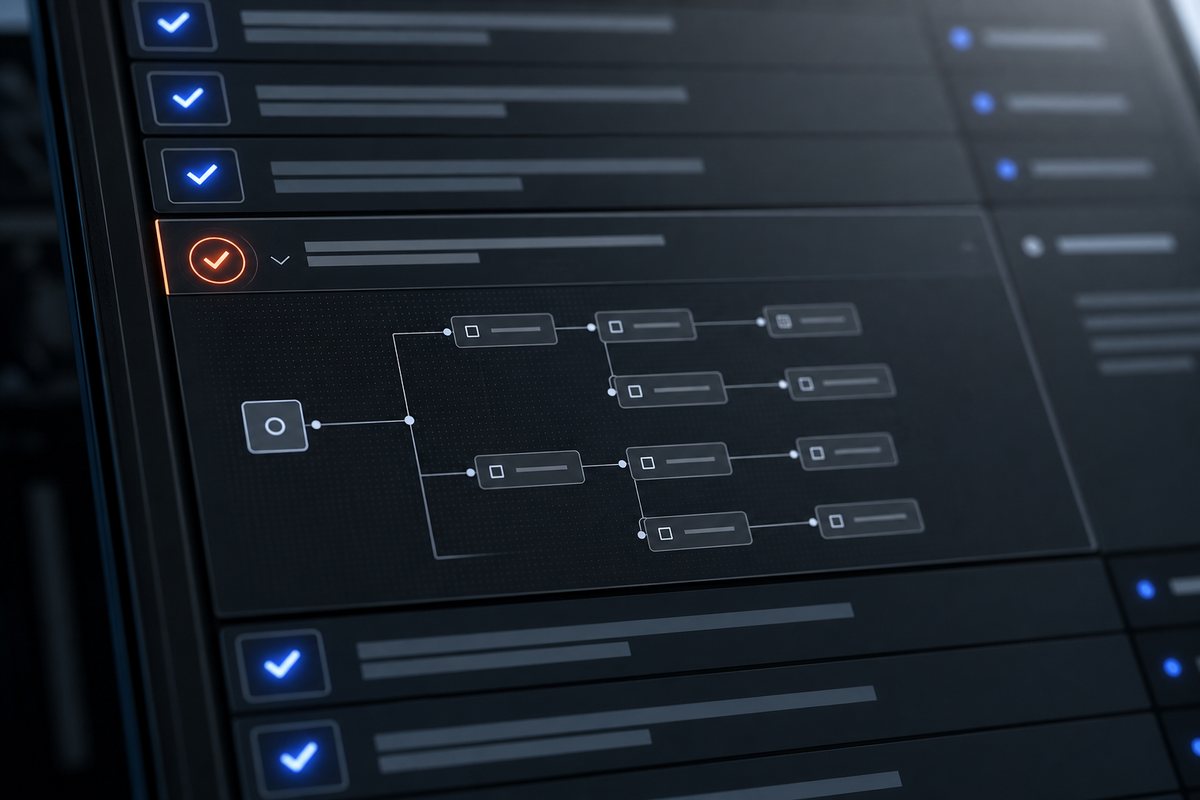
A process owner and a VYROX engineer reviewing a decision framework together on screen

Every stage has a human checkpoint.

The framework is reviewed with your process owner before it is trained. The tuned operator is tested against historical decisions before it goes near a live case. Live runs start supervised, with your team holding release, and every disagreement is logged and discussed rather than quietly resolved either way. Nothing moves to the next stage on our judgement alone.